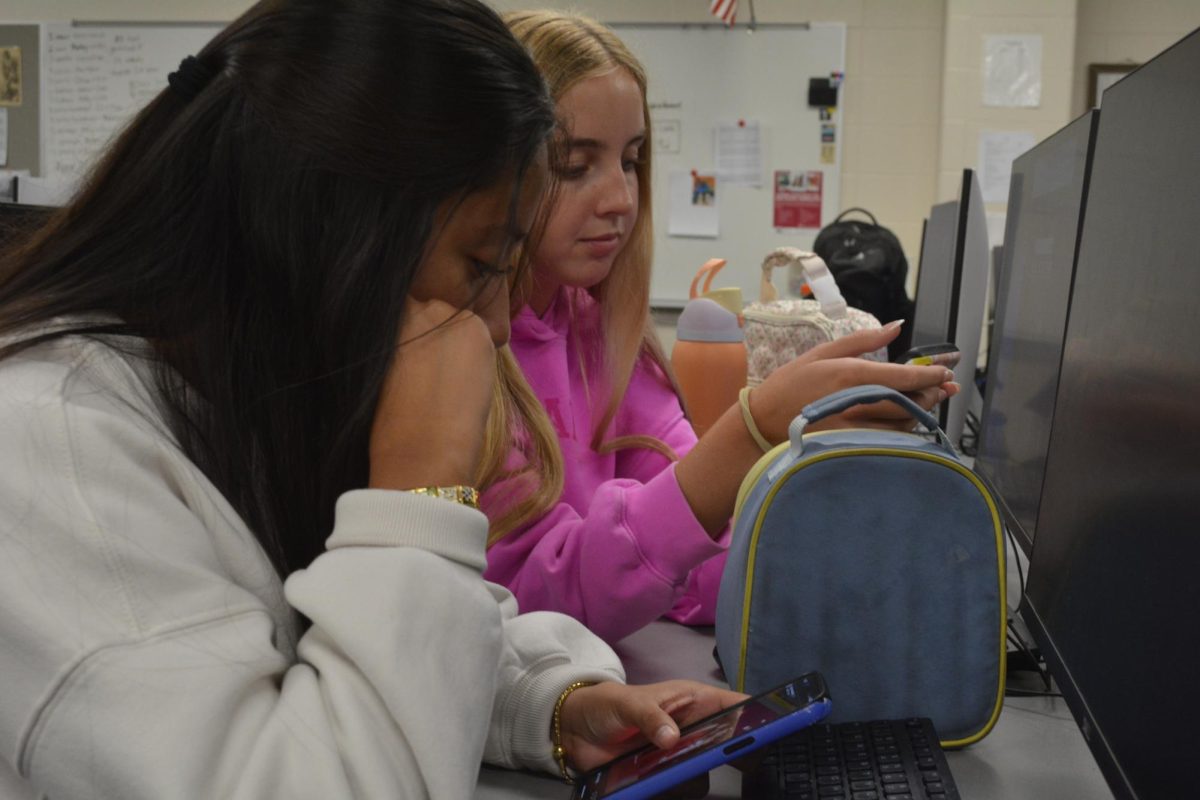
Indiana Legislators have passed a law to further restrict the use of cellular devices in schools. Taking effect July 1, students can not have cell phone use during any part of the school day.
The intention behind this law is to enhance test scores and improve academic performance.
“I hope to see it have a positive impact on academics. Sometimes we have student conflicts during the passing period or lunch when students get caught up in drama because of social media. So if we don’t have that during the day and after school, maybe it will give the students time to diffuse rather than dealing with it during the day. It could have an academic impact in individual cases, but overall, our students have done such a good job with the current phone policy,” Mr. Michael Gasaway, principal, said.
This change is much different than the current rules regarding phones.
“The new legislation states from the starting bell to the ending bell with no access for students to their cell phones. Where those cell phones will be is undetermined, but they will be shut off and out of sight. Their part in the classroom should not change because they should not be in class anyways, but this will be an adjustment period for phones from the start of the day until the end of the day,” Mr. Craig Bruns, assistant principal, said.
Additionally, the law prohibits students from using personal devices, such as their watches or laptops.
“What was included in their law was tablets, gaming devices, and smart watches. Smart watches would be on that list. What it is going to come down to is that the only thing that is going to be technology driven is whatever the school is giving to the students. Students will no longer have their own device. The school will give them their own computers,” Mr. Gasaway said.
Some schools have plans to or have already adapted Yondr pouches or other products to stop student use of phones during school hours.
“At this point, we are not buying the Yondr pouches. I anticipate that what we will be saying is that it has to stay in the backpack and not on the person. The issue is having to police students during the school day and restrict their access to phones when the phones are in their backpacks,” Mr. Gasaway said.
Some teachers and staff say that restricting phones for the entire day is a move too far for students.
“I disagree with it. I’m not a fan of people who have no experience in education writing educational law. I have not been in favor of any kind of ban on cell phones, but I’m much more agreeable to school developed policies than I am to state developed policies because I don’t think the needs of Greenwood and Muncie are the same. I think cell phones could be used in very positive ways in school, if you have a well-supported discipline system,” Mr. Rich Perry, science teacher, said.
Perry explained his thoughts about student behavior with phones in the classroom.
“Our state likes to write blanket policies instead of addressing the actual problem. When a student is on their phone during instructional time, and they respond appropriately to the teacher saying to put their phone away, then those kids will follow the policy. But there are students who regardless of what the teacher says will use their phone. Taking their phone away won’t change much because they already weren’t good students. So I don’t think taking away phones will see an improvement in achievement at all,” Mr. Perry said.
Other teachers and staff agree with the law and regulations on student use of phones.
“You see a lot of research that is coming out with the dangers of social media on younger individuals so I can understand the desire to restrict that or limit that. I’m not well-versed to know everything behind that, but I can understand why Indiana wants that. I try to keep my kids off their phones for various reasons so I can see why they are trying to move in this direction. I’m one for less distractions during the school day,” Mr. Bruns said.
Discipline for students violating the new policy remains undetermined.
“All the schools are dealing with this, not just the schools in Indiana. I don’t know if our discipline policy is going to change. If you get it taken away, then it comes to the office. The kids here do a good job abiding by the current policy so I have no concern with the students adapting. I wish we could continue with what we have in place. What we have in place has been better for teachers,” Mr. Gasaway said.