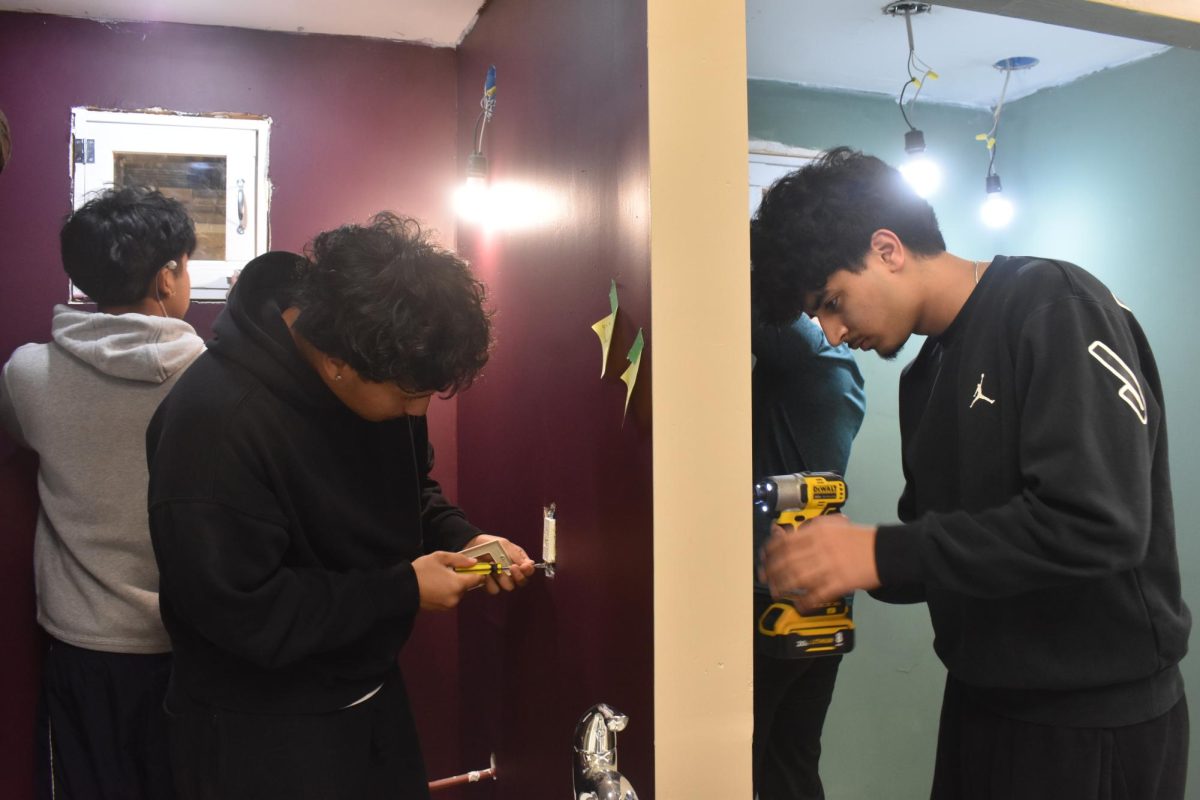
Tucked into the corner of the school, a kitchen, bedroom, bathroom, and living room are all under construction.
Each year, Mr. Allan Figy’s second level construction class spends their time in the classroom putting the skills they learned to work as they build a small house from start to finish.
“Mr. Hagerty came up with the idea of building a room and completing all the interior finishes for it. Since then, we have done this every year. This is our second complete year of doing this,” Mr. Figy said.
Beginning with the blueprint and finishing with furniture, students have ample opportunity to discover and improve their skills.
“The students are doing the framing, the wiring. They are adding the drywall, building windows, painting, adding flooring, and then they will build furniture to add into the room once it is done. For example, the bedroom will get a night stand, and the students working on the bathroom will build a medicine cabinet and hang it up. They will be exposed to a bunch of different skills throughout this process,” Mr. Figy said.
Some students prefer working on specific components of the house over others.
“Drywall was one of my favorite things to work on. When working on drywall, you have to make sure that there are no bad spots, and if there are, that you go over them again before painting. In our room, one of the corners was really messed up, so we had to rip it out and redo it. That is just part of the process, though, so once we put it in place and had it fixed, we were ready to paint it,” senior Jaxson Pierce said.
Each student works on constructing one of the rooms in the house, either a kitchen, bedroom, bathroom, or living room, with a small group from their class. This ensures that each student will practice all the components of building the house. Once done, each of the four types of rooms come together to create the full small house.
“I am working on one of the living rooms. Right now, we are painting it, which is my favorite thing we have done so far. There are some other things you have to do before painting. We had to sand it and then add primer too and make sure everything was all smooth, and then we could paint. It is definitely a good experience in getting different skills. I would say I am doing pretty good with learning all of these skills, and I like how it is more hands-on than a normal classroom,” sophomore Alan Ibarra-Iniesta said.
The small houses are torn down at the end of each year, and the supplies are reused for the next class. Some supplies, such as the paint, are donated, and some supplies must be purchased new each year.
“The theater department gave us seven gallons of paint for us to use. We can cover one room with about a half a gallon of paint, so teachers and staff usually donate paint for us to use. At the end of the year, this will all be taken down, so we will reuse the framing and flooring for the students next year. I have to buy new drywall and wiring for them to use each year. Usually, I buy drywall that is partially damaged, and that gives the students an opportunity to work on patching it up and fixing it,” Mr. Figy said.
After working on the interior components of a small house, construction students can advance to the third level construction class where they will work on exterior finishes of a small storefront.
“The students do all the exterior, so rubber roofing, metal exterior, and adding some metal studs too for the storefronts. The level 2 class is focused on the interior side of things, and then this level 3 is much more exterior,” Mr. Figy said.
Some students have applied the skills they have gained from this class to other projects at home.
“My whole room was basically built by me. I made an L-shaped desk, my bedframe, cabinets to store clothes, and a small bunk that goes above my coat hanger, just all the furniture for my room,” Ibarra-Iniesta said.